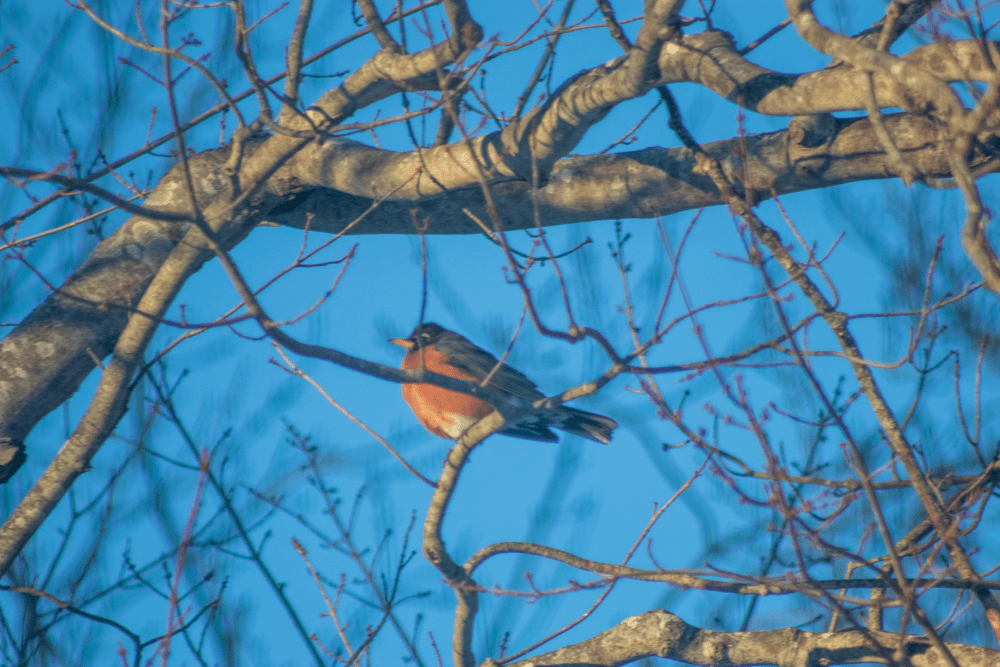
Today is a cold, bright, snow covered day, following Saturday’s storm that brought the birds to the feeder in mass.
Yesterday morning we were meeting friend’s early, for a long delayed cup of coffee, and were exultant to discover that “the guys” had cleared our driveway. We have now managed a healthy winter, certainly ending the snow drought, and hopefully have gone some distance towards recharging the aquifers.
It’s been very cold and snowy, reminding us of life in Northern Vermont. Last evening as we drove home from meeting with a group of poets, the light was golden, as it can, perhaps, only be in February. It was breath taking, really, and I wished I had brought a camera. I’m still waiting for the shadows on the snow to turn February blue.
The time has just turned 10:00 a.m., and I just finished my morning cup of coffee. I’ve enjoyed nursing it along for the past hour and something, not minding that it was room temperature in the end. Amazingly, the deep cup held its heat even here in the sound studio.
Speaking of sound, while at the poets’ meeting yesterday afternoon we were asked to introduce ourselves. It was all very relaxed and a tad playful and I did not include music and sound art in my introduction. Sure enough, someone very pointed added, “and sound artist.” It was a lovely moment.
The meeting was part of a series of gatherings on the theme of nature, belonging, and living here on the South Coast. Jennie and I are scheduled to lead the conversation at the next meeting in the series. Our topic is “place and belonging,” a complex weave for sure.
One of the core questions we will be exploring is whether belonging encourages us to stand up for local ecosystems. There is a general ethos of conservation in our generally affluent local communities, and speaking up for the needs of ecosystems and their inhabitants is a time honoured tradition. It is unlikely anyone will be killed for doing so, unlike so many places across the planet.
It is one of life’s ironies that our local comfort shields us from the dangers faced by land and water protectors around the globe. It is easy to forget that our affluence has come via the destruction of much of the planet, and that monied interests and their extractive technologies continue to threaten communities and ecosystems pretty much everywhere.
It is also too easy to forget that many of the persons who are killed or disappeared as they fight for the survival of their local communities and ecosystems are Indigenous, and that Indigenous women are disproportionally targeted.


Leave a reply to Yetismith Cancel reply