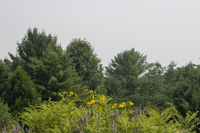
An early morning of light showers following a night of much needed rain. Areas north of us received a thorough soaking but by the time the rain arrived here it had diminished. Still, the air is fresh and cool and the landscape, which had been parched, renewed.
The humming birds are here after a summer in which they have been largely absent. They are drawn to Jennie’s gardens which are lush with morning glories. Other birds are enticed by an abundance of sun flowers. After a week’s absence, the catbirds are back in their bush and the gardens. In the verges alongside roads and fields late summer wildflowers are abloom.
Down at the beach all of the osprey chicks have fledged and, often, when we drive by the nest is empty. This is the time of family outings as the youngsters learn essential skills and the parents prepare the brood for the journey south.
A little while ago, while Nori was settled before the screed door to our bedroom, two sparrows landed on the deck some four feet away from her and began chirping at her. Birds, other than the crows, generally ignore Nori so their complaints left me to wonder whether one was a fledgling. Nori began to answer them and there ensued an inter-species conversation that lasted some minutes before everyone lost interest.
I’ve been reading nature writers who wrote in the mid decades of the last century. Nature writing, especially country journals, had an enormous following back then and appeared regularly in many national periodicals, including the New York Times. Those were the decades of increasing environmental awareness and activism, and the exodus from the countryside to cities and burgs was recent, leaving a strong sense of nostalgia in readers across the country.
Reading those country journals one gets a sense that in spite of large environmental issues, the natural world was largely unaffected by human actions. Seasons unfurled in a more or less predictable fashion and humans had to live with the moods and actions of Nature. Still, I can’t help but wonder how much of this writing glossed over the growing threat to all ecosystems as authors sought to provide readers solace after the war, and during an age during which atomic annihilation seemed likely.
Those were decades in which city dwellers kept nature journals and regularly left the city to find relief and renewal in nature. There was little to indicate the great divorce from Nature that was about to come.


Leave a reply to Michael Watson PhD Cancel reply