
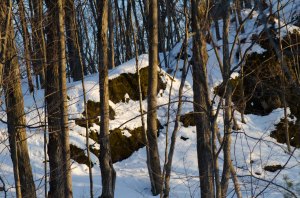
 A clear, crisp, bright late January day, deep snow pack melting away at the edges.
Oh, wait! It’s March!
I’ve just finished reading Freshwater by Akwaeke Emezi. The “biographical” novel narrates the life of a Nigerian girl born with one foot in the physical world and one in the spirit world. As often happens to those born straddling the worlds, this young person, whose name is Ada, lives a childhood filled with trauma. As a result she finds herself host to spirits and “personalities” who interact in a complex, often conflicted, web of relationship.
From a Western frame of reference Ada clearly meets the criteria for Dissociative Identity Disorder. From a Nigerian frame things are far more complex.The book is narrated by Ada and her many “selves”, and offers a glimpse into both dissociative experience and cultural difference.
Reading this book set me to remembering. Almost twenty years ago I was visiting two of my teachers on the Rio Negro in Brazil. We spent one day with a lovely woman who practiced Candomblé. She was a trance medium who allowed a set of spirits to inhabit her body and thus speak through her.
That night, I developed a high fever. In a haze of howler monkey screams, jaguar snorts, and other jungle sounds the medium visited me. For what seemed hours she taught me what she thought I should know, a gift for which I remain most grateful, even as I continue to unpack the experience.
The following morning I awoke exhausted. In the days and weeks that followed I realized that my very Western view of self was inadequate. I found myself with the increasingly uncomfortable experience of being larger and more complex than I could either hold or know.
Jungians often speak about “the I” and the “Not I.” The medium was clear about which entities were other, about her boundaries. For her, the spirits that “rode” her were “Not I.” I was much less certain as to who or what constituted me as an I.
Many shamanic traditions share the belief that our bodies provide a container for multiple souls. One such soul approximates personality and may have many incarnations. Another soul is a nature soul and returns to the landscape after our physical death. A third type of soul is responsible for animating the body and returns to the World Tree after death, where it awaits reincarnation. A body may contain a multitude of souls who, ideally, communicate and cooperate as a system that experience the world as an I.
Trauma complicates the experience of I, as the mind of the traumatized child fragments in order to compartmentalize traumatic experiences and make life bearable. Severe abuse, especially at the hands of loved caregivers, may enhance dissociation, resulting in “parts of self” that act as if autonomous I’s. For persons already living with “one foot in each world” this may result in a profoundly complex inner world, one that deeply troubles identity.
From the shamanic point of view we are each immense, multiple, and complex, and ideas of I and Not I are simply constructs that allow us to negotiate physical bodies and the world. Still, when one experiences severe childhood trauma, or when one lacks a social model for making sense of complexity and multiplicity, one may suffer greatly.
Good, trauma informed, therapy can aid parts of self to form better relationships and function more as a unified system, to become an “I” if you will. A compassionate, experienced teacher can help one build relationships with the spirits, to make a functional distinction between the “I” and the “Not I”. Sometimes, especially when one is born with a foot in each world, one may need both.


Please share your thoughts and join the conversation!