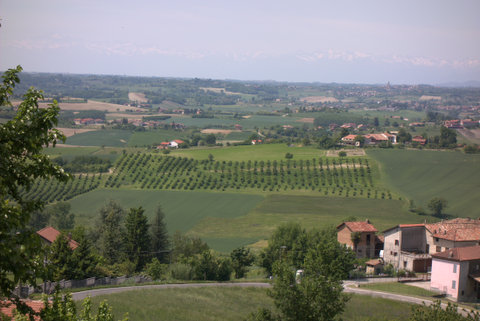
 We were visiting cousin Toni and her family in a hilltop, walled village near Torino. Looking out across the landscape we saw castles, and their villages, atop each of the many surrounding hills. Between each village lay fertile fields and the occasional woodland. Vineyards and orchards appeared here and there across the countryside. The Alps rose craggy in the distance.
I asked about the presence of so many castles, and was told that for many centuries there was conflict between villages. These conflicts were not simply local, but reflected larger forces at play in northern Italy. The fertile landscape spreading out before us was a much coveted resource, fiercely contested among local and international powers. Thus, life was difficult for the people of these beautiful hilltops and valleys.
In the village wall, just steps below our relative’s home, were the impact craters of bullets. During World War II, thirteen village men had been executed against that wall, killed by the Nazis in revenge for the death of one soldier. The men, including the village priest, had been taken as they left Sunday morning mass at the local church, lined up against the wall, and shot. The village still mourns.
Today, Italy is at peace. Her people, still face, of course, many challenges. There are few jobs for young people, so the young leave for other companies, an exodus reminiscent of other generations. People grumble that the government seems incapable of addressing the real problems faced by Italians; that, too, is familiar to Italians across generations. Yet, much works: education is essentially free, as is healthcare. The country’s infrastructure is excellent: the trains are inexpensive and run on time, the roads are well-kept, and the electrical grid generally dependable. Internet speeds are slow, an inconvenience that has no immediate solution.
 Still, the history of conflict and warfare lives, often just below the surface of everyday life. That history, perhaps carried in the genes of each generation, permeates the landscape, culture, and local history. Stories arise in many contexts, even at Sunday afternoon brunches, or neighborly gatherings around the table beneath the fruit trees in the garden. Even in the immediacy of peace and relative prosperity, trauma sits nearby, never far away.
As we enjoyed a classic, home-made Northern Italian lunch, complete with great local wine and desert, I thought about the way North Americans ignore the needs of the land, and the history it speaks to. I pondered our willingness to consume expensive, tasteless food, rather than nourish the land and those who farm it, and wondered what might lie beneath our collective obsession with covering the land with concrete, as if history would not, like Nature herself, force its way to the surface through every crack.
Listening to the flow of stories, I mused that I often hear that America has not experienced war on our soil, yet know our land has witnessed much warfare and bloodshed. I imagined that the soil of North America, like that of Northern Italy, remembers, even as we try desperately to forget.
Looking at the people gathered around the table, it occurred to me we North Americans could, as has much of Europe, choose to embrace the land and the history it holds, and build a society that honors the histories of the places we inhabit. Perhaps we would all be happier then.


Please share your thoughts and join the conversation!