A lovely, partly sunny, late spring morning following a showery night. We are told more rain will arrive later in the day.
We are in that magical moment when so much is in bloom. That said, the earl flowering trees have moved on to putting out leaves and the landscape has closed in accordingly. The past couple of days we have been visited by a solitary hen turkey; we hope she will nest nearby and bring her brood to hang out in our yard. Watching the chicks grow is one of summer’s abiding pleasures.
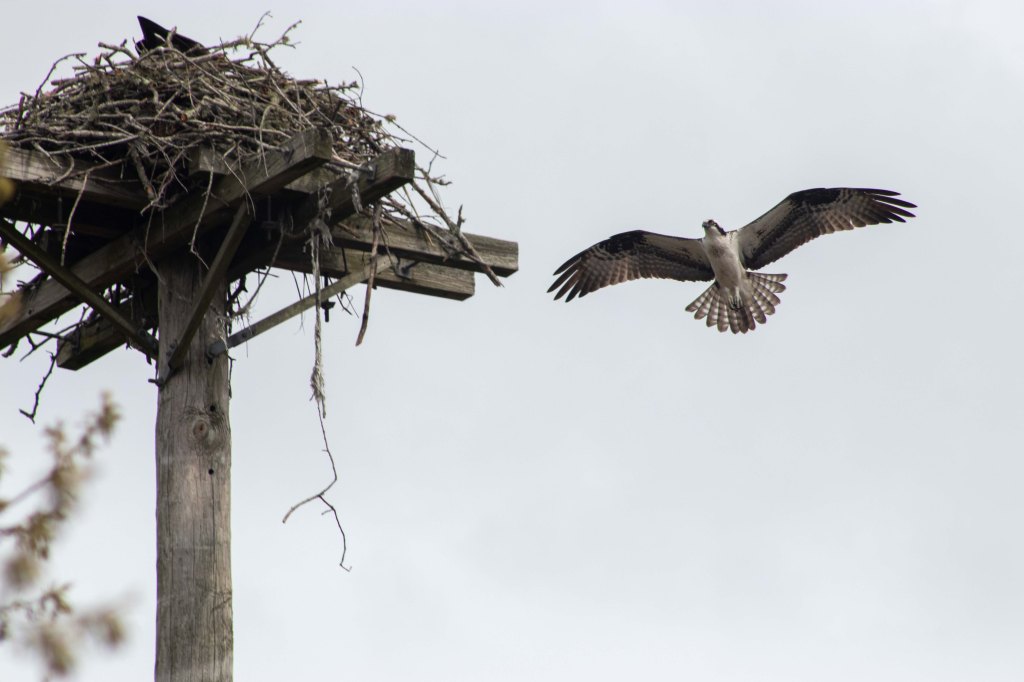
The osprey are engaged in nest building, with some pairs already apparently incubating eggs. In locations where they are used to people one can get quite close, and watch them go about their days without disturbing them. (Their nests are very high up!) They are magnificent birds who truly seem to find joy in flight and relationship.
I tend to be careful when reading human feelings into the behaviour of other species, while also recognizing that we living beings share much experience across species. I suspect the real danger is in pretending other species don’t share our experiences as that tends to other, and lessen, them.
There was a study out this week that found that in a billion years or so the sun will be bright and hot enough to break down most CO2 on earth, at which point trees will starve and stop producing oxygen, meaning that the earth’s atmosphere will no longer support complex life forms. (This timeline is 2-3 billion years sooner than previous estimates.) Methane will also become a much larger percentage of the rapidly thinning atmosphere, making the earth a very inhospitable place.
One of the lovely things about such research is that one can make predictions without too much concern about their verifiability in the near term. Living systems like the earth are complex and evolving so there is more than a fair amount of unpredictability when imagining the distant future. We may be pretty certain life as we know it won’t survive but that does not necessarily mean the only living organisms left on earth would be anaerobic bacteria.
What the study does show, I believe, is that those of us who are alive on this spectacularly beautiful, life encouraging planet, are being given a great gift: we are alive and aware in a moment, brief in terms of the universe, when life is flourishing on a relatively rare, hospitable, planet. I wonder what would happen if we could collectively grasp that we, and all other organisms, are being given a supreme, truly priceless, gift?


Leave a reply to Michael Watson PhD Cancel reply