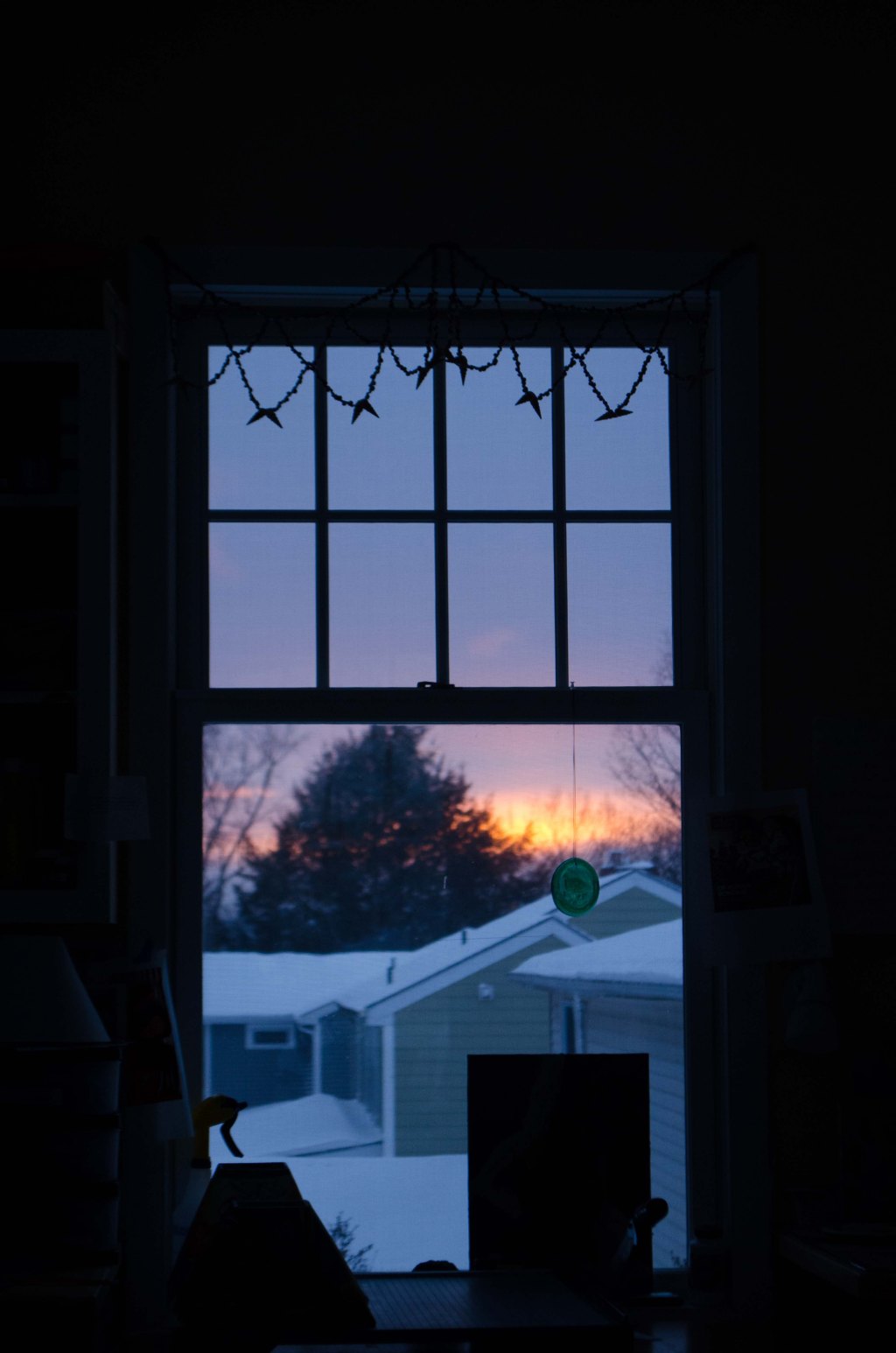
 A chilly week, light snow now and again but not enough accumulation to halt the shrinkage of the snow pack. Today is forecast to be warmer with snow and rain. The perfectly shaped, leaf-bared maple tree that is framed by our office window sways vigorously in the brisk breeze.
We have a morning ritual: a cup or two of strong Indian tea. This morning we had our first cup in the sun room as we watched the local squirrels dash about the yard. They have been on the squirrel proof bird feeder where they quickly consume enormous quantities of seed. We’ll have to add hot pepper to the next batch of seed in hopes of deterring their thievery. The birds eat what they need, leaving the rest. The squirrels take all they can get. Most likely they will misplace most of their cache and come spring sunflowers will sprout all over the yard; few plants, if any, will make it to maturity.
Our overwintering birds depend on feeding stations, especially during brutally cold or stormy weather. Fortunately, many people maintain feeders, so there is a good deal of redundancy in the system and the birds seldom go hungry. This means we can go away for a week or two and not worry about it.
In much of the world the necessities of everyday life are no longer maintained locally. Rather, we depend on immense, human-created networks of distribution for our food, heat, light, water, and even waste disposal.
Very often these networks are tightly integrated and dependent on the trustworthy flow of electricity and information, making these systems shockingly unstable and highly susceptible to massive disruption events. When the electrical grid or the internet fail for any length of time, our lives become much more unpredictable.
On some level we are aware that our local networks are susceptible to disruption. The electricity fails during storms and the internet fails occasionally. We may even notice the effects of regional perturbations, such as last summer’s hurricanes in the Caribbean and the Florida Keys, yet we seem unable to collectively grasp the likelihood of large-scale disruptions to our regional, national, and international networks as a whole.
From inside our carefully woven electronic cocoons, we experience these networks as largely stable, even as the likelihood of large-scale disruptions to these systems increases. It seems we are hard-wired to ignore the precariousness of our situation, a condition that makes it difficult to take steps to create more resilient systems. We are a lot like the birds, trusting that all will continue to be well. Unfortunately, the systems we depend on lack redundancy, leaving us disquietingly vulnerable.
Addendum: Just after I posted this, I looked out the window and noticed a kestrel in the redbud tree next to our neighbor’s feeder. That meant birds using the feeder on our front porch were also at risk. A lone chickadee carefully watched the kestrel from behind. Then a flock of small birds joined in, flying around the raptor until she gave up and flew away.


Please share your thoughts and join the conversation!