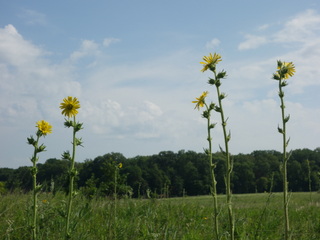
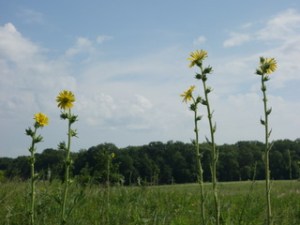
 After a day of storms, today is sunny and humid. Over to the west, cumulus clouds build.
Just south of Bloomington, Illinois, lies Sugar Grove Nature Center, a nature preserve, and the largest remnant tract of prairie grove in the country. (I stand corrected: it is the largest tract in Illinois). The preserve occupies a rare ecological niche, combining prairie and patches of ancient woodland. Walking through the prairie, never far from the forest, one hears a torrent of birdsong, even now at midsummer. Butterflies and other insects are present in abundance. Out here on the prairie the sun beats down and the humidity quickly saps any ambition from the walker, save the desire to retreat briefly into the coolness of the woods.
Look up and the Midwestern landscape is dominated by the great arc of the sky, dwarfing even the tallest trees in each grove. Closer to hand are the flowers and grasses of  the prairie which form dense thickets that average about four feet tall; occasionally sunflowers and mullein shoot up eight or nine feet above the prairie floor.
When the first European settlers arrived they viewed the prairie world as both beautiful and threatening; they also grasped its potential as a source of grain. Immediately they began to till under the wildflowers, quickly transforming a magnificent landscape into farmland. Soon the bison, elk, and most of the deer were gone, as were the Native people.
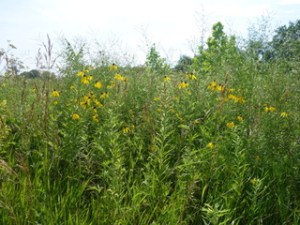 Standing in the tall prairie one finds oneself situated between Earth and Sky, and between two vastly different ways of understanding the land. Where Europeans saw farmland to be tilled, Native people saw a landscape rich in beauty, food, and culture. All too soon the settlers’ vision of tidy farms would rule the plains, and one of the world’s most vibrant ecosystems would exist only in memory, and in small, remnant, enclaves.
The settlers imagined the Native people of the Midwestern prairies did nothing to manage the prairie. What they missed was 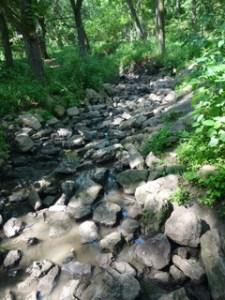 the prairie being managed in an entirely unique way; while the Indigenous people tilled only small plots, they burned the prairies regularly, stopping the advancement of forests and maintaining the complexity and vibrancy of the prairie ecosystem. What the settlers saw as negligence was simply a different form of land use and management. Now a few dedicated descendants of those early settlers strive to bring back the prairie, sans large herbivores and predators.
Standing here, under the high dome of the sky, the songs of birds and buzzing of insects creating an immersive aural surround, we are at the boundary between cultures, worldviews, and ecosystems. Standing in this remnant prairie, thinking about journeying lightly 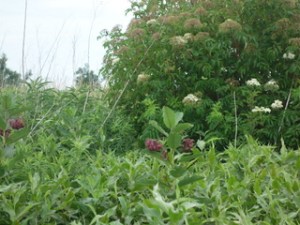 upon the Earth, is a good place to be.


Please share your thoughts and join the conversation!