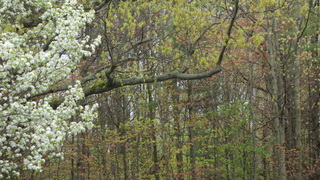
 Our local weather has been cold and damp, and I am still wearing flannel. Apparently, light rain fell for most of last night; this morning the world is a lush, the trees having suddenly made the transition from a diversity of early spring colors to myriad hues of vibrant green. The red bud in our neighbor’s yard has defied the arborist’s forecast and made it through another winter; I have the deep pleasure of looking at the luscious dark pink buds and flowers through the window next to my computer.
Last evening we went for a walk in the woods behind our home. The wildflower season has progressed while we weren’t looking and the white trillium and yellow mayflowers are out in their splender, as are the columbine. Jennie thinks there are fewer wildflowers now than when we moved here ten years ago, a trend we seem to discuss each year. The same sense of decline accompanies the local songbird population; especially hard hit are the flycatchers who are in dramatic decline.
We passed neighbors along the way, and of course the topic of ticks came up in the ensuing brief conversation. Here in Vermont we’ve experienced a rapid rise in tick populations and tick borne illnesses, and with it, a growing fear of the natural world. The sad truth is that the woods and fields we have always freely roamed have become downright dangerous. For about a decade we have noticed that each year more clients, students, and friends talk with us about their growing fear of the outside world. This year, with an explosion in ticks and the advent of new, and potentially deadly, tick borne viruses, the fear has become epidemic, as has the grief at being forced to largely abandon going into the natural world.
The rapid expansion in tick populations is a harbinger of larger, even more threatening changes to our regional ecosystem, changes that are hardly unexpected. Throughout my life I have wondered why people thought we could have both an ever-expanding population and economy, and a cohesive, vibrant ecology. There is only so much energy available to an ecosystem, and we humans have a long trajectory of utilizing ever more of the resources available to the world around us; the other organisms with whom we share the world have to make do with whatever remains. There should be no surprise that extinction rates are high and rapidly increasing, nor that the populations of organisms, like ticks, that are accomplished at taking advantage of newly opened niches in ecosystems would increase.
As our world becomes less complex (I’ve lived long enough to experience this trajectory first hand), I feel increasingly lonely. Lately, I find myself deeply mourning the loss of diversity and companionship, and disconcerted by the growing silence emanating from the non-human world. Given the denial and indifference practiced by so many, I wonder where this will lead and what may be left for my old age, my grandchildren, and those children who will enter the world in seven generations.


Please share your thoughts and join the conversation!