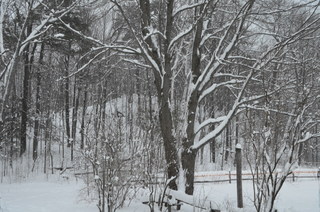
 Snow fell much of yesterday and last night, our first real storm of the year. This morning we awoke to turbulent skies and deep powder snow. Now, the birds are busy on the feeders; there is no sign of the squirrels. The breeze, which had been calm, is picking up, promising a raw day.
Yesterday, before the snows came, I was sitting at our kitchen counter, overlooking the woods. Out of the corner of my eye I noticed movement and looked up: a magnificent red fox was at the back of our yard. Immediately, it rose up and grabbed a gray squirrel that was headed up a tree trunk to safety. As we watched, the fox began making its way steeply up the hill, trotting through a few inches of fluffy snow, and stopping occasionally to look around or to re-position the prey in its mouth.
A few minutes later it returned, sans squirrel, and again climbed to the crest of the hill. As it neared the crest, it stopped abruptly, then quickly headed back down and out of sight to our left. Almost immediately, a large dog appeared at the top of the hill, leapt high into the air, then disappeared again over the crest.
We feel blessed when able to witness other creatures going about their lives and deaths. These moments are inevitably complex, often holding elation and grief, joy and trepidation.
In the non-human world death is quite often instant: several years ago I was walking through an alley in a densely residential district of town. Before me, a flock of pigeons was feeding. Suddenly they arose in a great whirring; simultaneously, I saw a streak of light pass by. The flock settled back to the ground amid a rain of feathers. I never identified the raptor, although I have always imagined it was a peregrine falcon.
Living close to an urban forest we are routinely reminded that for many this is an age largely devoid of the natural world. As a population we sit before our screens, insulated from the immediacy of nature, removed from life and death as the stuff of the everyday. Increasingly, we live in a post-postmodern world where “reality” is disembodied, fragmented, and distanced, where lived experience is challenged and discredited, along with consensus and fact.
The postmodern, that discipline-challenging theory of knowledge, came as a relief for many. Finally, the carefully manicured history of the dominant culture might be challenged and room made for a diversity of lived cultures and worlds. Yes, the center no longer held, but this was OK. The new work was to find a new center, one that made space for the histories and practices of the many, rather than a select few. The task was to find an inclusive view of human nature, one that acknowledged the enormous variety and complexity of human experience.
Yet, there was, one might argue, a sort of center, a starting point on our quest for a grand view of humanity. Most people had exposure to some aspect of nature on a daily basis. While we might argue about our place in the natural world, our order in the Great Chain of Being, we were pretty much in agreement that we belonged here, that we were, and are, expressions of Nature.
Now that consensus is gone. Nature as a reference point, as a shared condition, has disappeared from the lived experience of many. Suddenly, we find ourselves adrift, deprived of context, and devoid of connection to the immensity of the nonhuman world. (In terms of our understand of ourselves, it matters whether god made the world 5,000 years ago, or Nature slowly, over billions of years, wove the immensely complex and fragile ecosystems we inhabit!) The risk is that without deep and abiding experiences of, and everyday connection to, the global ecosystem we call Nature, in all of its life and death complexity, we will lose our individual and collective souls.


Please share your thoughts and join the conversation!