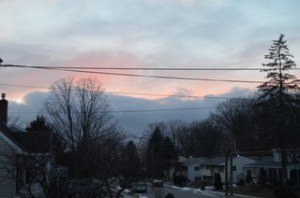
 The dawn revealed a world held in deep fog, the snow cover having melted away in this week’s warmth. Bare ground and limbs remain.
I’ve succumbed to the mid-January doldrums, and have taken to sitting before the fire with a good book. Occasionally I journey up to the studio and muck about. I’m not much good at blocking out the events of the world, nor have I been, historically, accomplished at working with the themes of the time, so I muck.
Being mid-winter, it is also basketball season. I grew up in rural Illinois where the sport was the very center of life in the village. The mood of our small community rose and fell with the fate of our local teams. Our high school team was consistently OK, but our middle school team was feared by all those who played in our division; years in which we failed to win the state championship were considered failures. Simply losing a game was an acceptable reason for team members to stay home from school the next day.
Still, being a primarily farming community, there was an innate understanding that no matter how talented a team might be, or how hard they may have played, things don’t always work out. There was, underlying the bravado and noisy support, a deep kindness that provided a sort of social safety net to those of us engaged in the sport. (I was one of the team managers.) There was, at root, a community conviction that as important as basketball was, it was only sport.
While there was much talk of basketball, and important middle school games might be broadcast on the radio, the metaphors used in everyday life were agricultural metaphors. I remember my father teaching a Sunday evening church class using tomatoes from our garden as the central metaphor for his lesson; he was speaking to adults.
Agricultural metaphors allow for more than a little ambiguity, and a good deal of chaos. Things happen. I remember riding my bike home through the fields in back of our house one summer evening around supper time. A nasty looking storm was quickly gaining on me. Suddenly, I was riding through hail that was three inches in diameter. Fortunately, when hail is that large, it is usually well dispersed, so I was only struck a couple of times, and not in the head.
Later that evening we went to our church, only to discover the hail had broken many of the windows. We were intensely proud of our church as we had contributed innumerable hours to its construction. The we in this was both a person and a collective one, our family, and several others were intensely invested in the building and growth of that church. We stood and surveyed the damage, then took up brooms and dustpans and swept up the glass. Within a week the windows were replaced and life continued; our garden also recovered.
In agricultural communities randomness is taken for granted. A tornado destroy one farm and leaves the adjacent one intact. One field receives rain all summer while the next field over sees nary a drop. My farm wins this year and fails next; the object is to have enough good years to protect against the inevitable bad ones. There is an assumption that I will eventually need the aid and support of my friends and neighbors, and they mine. There is only stability when there is mutual support.
Living with the vagaries of Nature offers a perspective that may allude folks who grow up in the city. Given the randomness of summer storms, late frosts, and drought, one learns that personal initiative, while certainly important, is never enough; one needs a certain amount of Divine support, and a good deal of luck to bring in the harvest. Agricultural metaphors acknowledge the play of chance and fate, while sports metaphors have a tendency to settle into variations of winning and losing, and the ideology of winner take all.
Our collective culture has become one-dimensional; everyone is reduced to being a winner or a loser. The community in which I grew up is suffering; drive though the village and you notice that two-thirds of the shop windows are boarded up. The young people mostly leave town as soon as possible; even the sports teams struggle. I gather that, like much of rural America, opiates are a scourge .
The politics of winning have left those small, human communities to struggle as best they can. They are seen simply the losers in the sport of life. No wonder folks who live there are angry.


Please share your thoughts and join the conversation!