
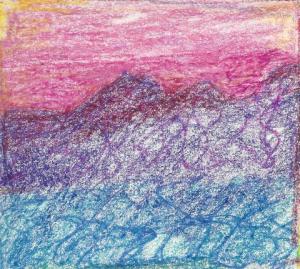
 While working in the studio this morning, I chanced to pick up an old sketchbook, one from the late 70’s. Looking out from the studio, across the mid-winter landscape, I paused to enjoy the long shadows and brilliant, snow-reflected sunlight. The contrast between sunlight and shade is strong this time of year, and as today was sunny, this difference was striking. When I returned to flipping through the images, I found myself wondering about them. Some drawings I remember creating, others not so much.
These drawings were made after I developed new Polio symptoms and before I was diagnosed, some ten years later, with Post Polio Syndrome. Drawing is an activity I still deeply enjoy and can engage in for short sequences of time. I miss the days when I could draw or paint for many hours each day. Looking through the sketchbook, I was left with a blend of emotions: pleasure, excitement, and grief.
I work with much grief in my life as a clinician and healer. A central task of healing from trauma is telling the stories and allowing oneself to grieve, and I am honored to hear many stories. One one side, the stories are rife with unimaginable cruelty, suffering, and loss. The other side of these narratives is courage, perseverance, and survivance, attributes highlighted by their proximity to deep shadows.
As I listen, I am aware that these stories call on all who hear, including the teller, to have compassion for the barer of such anguish. Self-compassion, a hard-won skill for most of us, opens the door to exiled parts of self, whose return will undoubtedly bring grieving for the loss of so much, including time. That grieving is ultimately a balm for the soul, providing we can hold it, and, eventually, move through it.
Grieving takes place in time, although in the midst of grieving time may seem to stand still. We humans are, after all, temporal beings; yet, for most of us, our capacity to experience deep, geological, time is quite limited, largely confined to imagining our life spans and perhaps those of our grandchildren or great-grandchildren.
Our concept of the future is shaped by our knowledge that our sojourn here is brief, perhaps 90 years. It is also formed by our past, which provides a yardstick against which we measure change.
When we note the ever quickening loses incurred by the rest of Nature, we do so against the background of what was normal for us growing up, and project the difference forward. At the same time, it is immensely difficult for us to hold the very long view that might offer solace of sorts, that is, to live in deep time. Thus, we grieve.
I am reminded of this as I engage in conversations with some of the young people we will be leaving the world to. They, too, find themselves face-to-face with grief, as the Earth they care dearly for seems to die before their eyes.
The task we all face, as we confront our mortality, life losses, and the threat of a greatly diminished future for our kin, is to find ways to grieve deeply, and to allow that grieving to transform us. I like to believe that grieving is a task we work at, as we discover how to do so, over time. Perhaps grieving is never fully completed; maybe we simply learn to settle for good enough grieving, a well enough done task.
I image that life offers us a promise: if we can weather the demands put upon us by it, we may step from the fire and ice of grief, into the remainder of our lives, transformed.


Please share your thoughts and join the conversation!