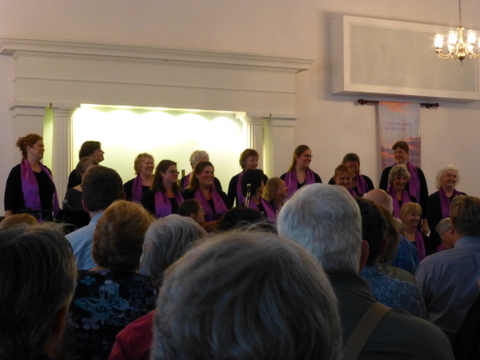
 Yesterday we traveled a short distance north, into the Champlain Islands, to attend a concert by our much beloved women’s choir, Bella Voce. The concert centered on Robert De Cormier’s, They Called Her Moses, a cantata about the life of the indomitable Harriet Tubman. The music was accompanied by a multimedia presentation that gave context to the story. Bella Voce had asked Dr. De Cormier to rewrite the cantata for women’s choir, and the performance yesterday closed the world premiere weekend. The music was joyous, disturbing, and profoundly moving.
As we drove home post performance, we talked about our experience of the piece. On one hand, the music was immensely uplifting. On the other, the focus on the “Freedom Train” ignores the suffering created by Jim Crow laws, suffering that lasted almost a hundred years, and which threatens to be renewed by a new generation of Jim Crow laws.
We spoke about the similarities between the safe houses that constituted the Underground Railroad, and similar efforts by people of good heart to provide safe exodus to Jews and others from Nazi Europe, and other endangered peoples from many countries, including Rwanda. In each case, individuals and groups took enormous risks to aid ruthlessly oppressed or enslaved people.
Then we spoke about our thoughts during the performance. Both of us had wondered why it is OK for us, as a culture, to remember slavery, but not to address the genocide of the Indigenous peoples of the Americas. How can we speak about the courage of Abraham Lincoln in freeing the slaves, while ignoring his war on Native people? How is it we do not speak of the millions of Native Americans who died in slavery in the South, or the intermarriage of African and Native American slaves? How is it that if one has any Indigenous African ancestry, one is Black, while one has to prove sufficient Native American “Blood” to qualify as an Indian?
I imagine there are many possible answers to these questions. One is economic: treaties between tribes and state and federal governments often contain provisions for the ongoing transfer of funds from said governments to tribal persons and governments. Thus, we witness ongoing efforts to disband tribes and disqualify individuals, families, and entire tribal communities. I suspect, though, the deeper issue is one of origins. There is a myth in European America that suggests the lands of the “New World” were given to Europeans by God, rather than taken from people who had lived here for many thousands of years. It is relatively easy to acknowledge the IMPORTATION of millions of Indigenous African people, for that implies the prior landedness of the European plantation owners. Acknowledging slavery serves to reinforce European claims to the land.
Yet the truth remains: The European colonists used germ warfare, rape, and massacre to displace the Indigenous people of the Americas. God did not give them the land; rather, they ruthlessly took it. The largely unasked questions remain: What does it mean to have created wealth from genocide? Do the Nuremberg Principles apply to genocide in the Americas, especially in North America? How might the European governments of the Americas acknowledge and make reparations for 500 years of genocide?
These are not rhetorical questions. Rather they are questions central to the ongoing displacement of Indigenous persons from the land, to the continuing genocide. They are questions that arise unbidden as we address the immediate and multigenerational impacts of colonialism in psychotherapy with Native people. They are the focus of many dinner conversations when Indigenous people gather. They arise spontaneously in my dreams, and in the visitations of my ancestors. They demand our attention because the suffering continues, because justice and healing remain distant goals.


Please share your thoughts and join the conversation!