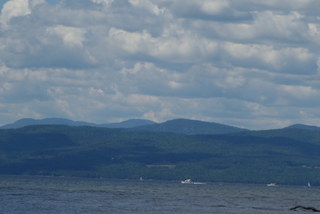
 It promises to be a hot, humid day, yet at this moment the world is refreshingly cool. A lovely breeze passes intermittently through the window, moving papers around on my desk and caressing my arm. Looking out towards the lake, I see the tops of the trees swaying and bobbing in the wind.
We are enjoying the mid-summer light. At mid-winter and in early spring our focus is drawn to shadow, vibrant and complex, but now light demands our attention, especially in the early morning and evenings. This year we have noted a change in the light, a consistent vibrancy and richness we have not seen before. What has changed? Could it be we are seeing differently, or simply that our memories are not what they once were? I wonder, is our fascination with light a form of nostalgia, a longing for what we will eventually, inevitably lose?
I’ve come to believe nostalgia has more to with what we have yet to lose than what we have lost already. Proust is, I imagine, speaking to us about his present and future, rather than his past. In this view, childhood becomes a metaphor for the tasks of late life, an invitation to regain a sense of immediacy, pleasure, joy, and ease that most likely was not truly present in our child years. By reframing the past we are invited to savor the fleeting present. There is, in this process of waxing nostalgic, a sort of anticipatory grieving, a letting go of what might or should have been, and a settling into the world as it is and may become.
This past week I found myself invited, seemingly at every turn, to contrast the present with a more peaceful past. For me, the week was more a deja vu, having grown up in the A Bomb threatened Fifties and the strife-filled Sixties, and having witnessed the violence of an out of control government and its proxies, including the KKK. I could only make sense of any feelings of nostalgia for a more peaceful, innocent time, as a wish for the future, as a reminder of dreams and aspirations still unrealized.
There also came a troublingly familiar sense that the future would be worse than the present, should there be a future. If I learned anything coming of age in the shadow of The Bomb, it was to take refuge in the fierce beauty of the natural world, a world now very much diminished and even more threatened. If I feel nostalgia for the past, it is for a past in which nature was more predictable, providing a context for our comings, goings, and efforts to make sense of ourselves and our lives. I grieve for the memory of a world not yet so diminished by our sheer numbers and greed, a nature rich in diversity and pattern, one largely incomprehensible save for moments in which I grasped fragments of a great pattern pf which I was apart.
I suspect that nostalgia for nature past is in some ways a looking forward to a nature of the far future, a recognition that nature is resilient and we humans are transitory. I wonder, did the dinosaurs, whom we now know may have been vastly more intelligent than we used to imagine, grieve for the passing of the world as they knew it? Did the early mammals fear a future they could not grasp? Did the lush vegetation of a much warmer world know deep inside it would, at a time far in the future, fuel the human epoch and reshape the world, drive climate change as the return of that which was deeply repressed, held under the surface for untold millions of years?
It is still relatively early in the morning. The steeply slanted light of the sun illumines the sides and bellies of the clouds, turning them softly gray-pink. The breeze has quieted and the heat and humidity of the day are building. I’m hungry, it being past time for breakfast; in a bit I’ll head off to work. This morning, this life, are a gift, although I do not always remember that. As I sit here, right now, I’m grateful for the day. I’m also feeling nostalgic for a time when we all wake up and hold nature, and one another, dear. I hope it comes soon.


Please share your thoughts and join the conversation!