
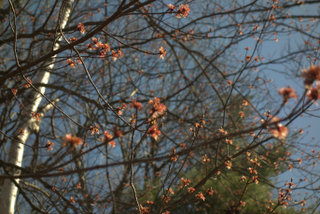
 This morning the birds at our feeder are quiet. Perhaps this reflects the return of chilly weather; yet it stands in contrast to the din that greeted us each morning earlier this week, when the temperature was above seasonal norms.
We love bird song, and have been saddened by the steady decline in songbirds, and song, over the past several years. Increasingly the possibility of a silent spring seems more threatening and immediate. This week’s cacophony of song was a welcome event.
I wonder whether children can grasp the enormity of our losses, having nothing to compare the present moment to. In order to understand change, one needs a reference point; initial conditions are the central stuff of stories: “Once upon a time”…..
We humans are literally born into story. My daughter came into this world during an ice storm, making the trip to the hospital an adventure story! Yet, aren’t all of our births and lives adventure stories? They are also coming of age stories (don’t we each come of age many times?), pilgrimage stories, and love stories. Everything we do, or experience, has the capacity to become story. All that is required is a teller and an audience, something Freud noted, as he developed his concept of the Superego, the internal storyteller who narrates us into consciousness. Freud believed that our self-awareness frames story; we know we were born and will die, that our time here, in this life world, is finite.
Of late, psychology, neuroscience, and literary theory has turned their combined attention to what seems another inherently human ability: the capacity to imagine alternative worlds. Story allows us to explore a seemingly infinite number of possible worlds; we imagine alternative futures and pasts, even alternative presents. This capacity for inhabiting a range of possible worlds is central to the work of Narrative therapy and much trauma informed work, offering the promise of healing.
Narrative theory engages us in thinking deeply about story, and about the possibilities inherent in rich story production. It reminds us that our worlds are structured by our neurology, by the function of our brains and nervous systems, and by culture and life experience. Other configurations might create dramatically different worlds; for instance, dogs share a world with us, even as their noses shape experiences we can only imagine. Who knows what stories earthworms or rocks, let alone Martians, tell.
I like to remember that the stories we live and share are in themselves expressions of Nature, and that even here, on this small planet, we interact with Others, whose stories, and worlds, are radically different from our own. It appears that Nature complexifies and diversifies over time, that it has a predilection for rich story development. Given the opportunity, Nature will explore all of the possible worlds and futures! Seen from this perspective, out very human need to make, and tell, stories becomes yet another expression of Nature.
Got a good story to share?


Please share your thoughts and join the conversation!